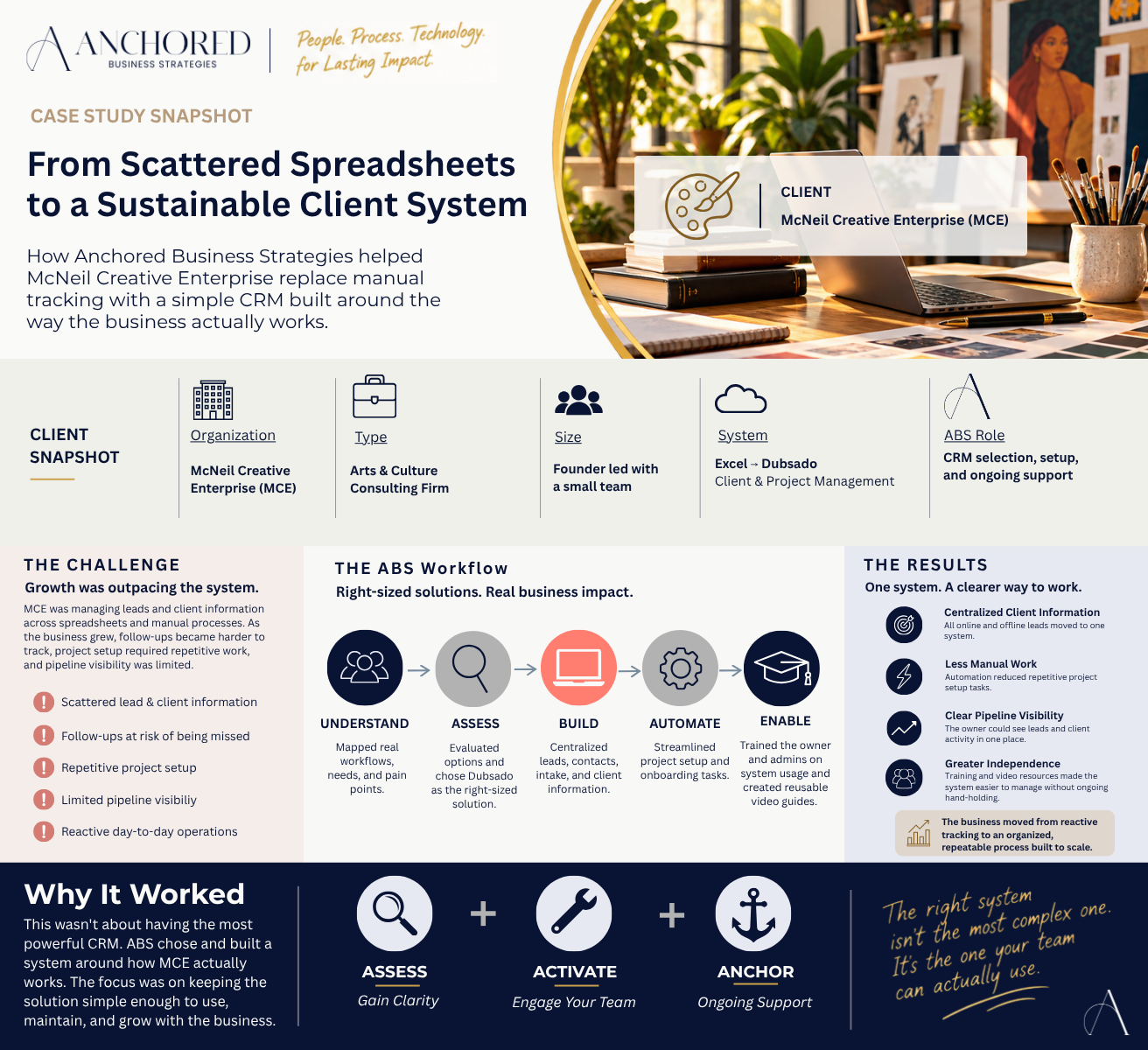
How a Creative Consulting Firm Replaced Spreadsheets with a Simple, Sustainable Client System

A case study in scattered spreadsheets to a clear, manageable client workflow.

Client Snapshot

  • Organization: McNeil Creative Enterprise (MCE) - learn more about MCE

  • Organization Type: Consulting firm supporting art organizations

  • Size: Founder-led with a small team

  • System: Excel → Dubsado 

  • ABS Role: CRM selection, setup, and ongoing support

The Situation

This wasn’t just an organizational issue.

  • Follow-ups with potential clients were delayed or at risk of being missed

  • Project setup involved repetitive, manual work

  • There was limited visibility into the sales pipeline

  • Day-to-day operations felt stressful and reactive

  • Growth risked outpacing the systems meant to support it

Without change, growth would continue to feel chaotic rather than intentional.

Why This Mattered

This wasn’t just a technology issue. It affected how people worked every day.

  • Staff spent excessive time fixing problems instead of doing meaningful work

  • Donation entry and reporting were slower and harder to trust

  • Frustration increased, raising burnout risk

  • Leadership lacked reliable data to guide decisions

  • A significant CRM investment risked becoming a system that people avoided

Without intervention, instability and declining trust would continue.

How ABS Helped

Anchored Business Strategies focused on right-sizing the solution, not overselling technology.

Rather than pushing a complex CRM, we:

  • Clarified how the business actually operated day to day

  • Identified what needed to be automated—and what didn’t

  • Prioritized simplicity, sustainability, and ease of use

The goal was to give the owner a system she could confidently manage herself.

What We Did

  • Evaluated CRM options based on real workflows and business needs

  • Recommended Dubsado as the best-fit platform

  • Configured the system to centralize leads and contacts

  • Created website intake forms that fed directly into the CRM

  • Set up automations to support project setup and onboarding

  • Trained the owner and admins on system usage

  • Recorded short training videos for ongoing reference

The Results

  • All leads, both online and offline, were centralized in one system

  • Manual project setup steps were automated

  • The owner gained clear visibility into her pipeline and client activity

  • Day-to-day operations felt calmer, clearer, and more manageable

  • Training videos supported long-term confidence and independence

Most importantly, the business moved from reactive tracking to an organized, repeatable process that could scale.

Why This Worked

This engagement succeeded because the focus wasn’t on “having a CRM.”

By choosing a tool that fit how the business actually runs—rather than forcing the business to fit the tool—the system became:

  • Easy to adopt

  • Easy to maintain

  • Ready to grow alongside the business

Technology supported the work instead of complicating it.

If This Sounds Familiar

If your leads live in spreadsheets, inboxes, or disconnected tools—and growth feels harder than it should—there’s a simpler way.

Anchored Business Strategies helps small teams choose and set up systems that bring clarity without complexity.

Let’s talk!

Previous
Previous

How a University Foundation Recovered Momentum After a Salesforce Go-Live

Next
Next

How a Statewide Advocacy Organization Turned an Underused CRM into a Growth Engine